Turn Interviews into
Candidate Intelligence.
Raw transcript in. Scored, shareable candidate report out.
No credit card required
50 launch spots available — 20% off forever
The Complete Candidate Intelligence Platform
From agent-powered audio analysis to professional PDF reports — every tool you need to make faster, more confident hiring decisions.
Ready to Use
Pre-built templates, form fields, scorecards, and PDF designs — start evaluating immediately.
PDF Reports & Custom Designs
One-click professional candidate assessments with customizable designs and GDPR-compliant reports.
Audio Intelligence
Upload audio interviews for 13 analysis dimensions — sentiment, speaker diarization, talk time, chapters, and more.
Scorecard System
Agent-suggested scores against your custom criteria. Review, adjust, and finalize with confidence.
Team Collaboration
Share assessments, coordinate hiring decisions, and keep your team aligned.
Fully Customizable
Tailor every aspect — from form fields and templates to scorecards and PDF designs. Your hiring process, your way.
Upload Audio. Get 10x the Insight.
Text interviews get 5 analysis dimensions. Audio interviews unlock 13 — including sentiment tracking, speaker identification, and real-time chapter detection.
Text Upload
5 analysis dimensions
Audio Upload
13 analysis dimensions
From Transcript to Finished Report
Set up your evaluation effortlessly, then let the agent handle the analysis and reporting.
Step 1
Upload Your File
Paste your interview transcript or drop in an audio recording. Audio files are automatically transcribed and unlock deeper analysis.
Step 2
Set Up Your Evaluation
Pick a candidate and template. Each template bundles a scorecard and PDF design, so one choice sets up your entire evaluation.
Step 3
Automatic Analysis
The agent processes your interview — text or audio — and scores the candidate against your scorecard. Review and override anything.
Step 4
Generate Your Brief
One click generates a professional PDF report — structured, shareable, and ready for your hiring team.
Listen to an Audio Interview
Marcus Henriksen — Business Development, 35-min recorded interview
Interview Recording
DemoTranscript
Good morning, Markus. Thanks for making the time today. I know you're coming in from Stockholm, so I really appreciate it. I'm Lena, senior talent acquisition lead here at Vantara. We're a B2B SaaS company focused on enterprise revenue intelligence. And today we're interviewing for the head of Business Development, DAC and Nordics. The role is a senior individual contributor position with a mandate to build a regional team over the next 18 months. Shall we get started?
Absolutely. Lena, thank you for the warm welcome. I've been really excited about this conversation. The combination of the enterprise focus, the European expansion mandate and the stage VANTARA is at, scaling from a strong Series B foundation feels like a very natural fit for where I am in my career. I'm ready whenever you are.
Wonderful. Let me just give you a brief overview of how we've structured today. We'll spend about 35 to 40 minutes together. I'll start with some behavioral questions around leadership and team building, then move into more technical questions about your sales methodology and pipeline approach. And we'll close with a couple of questions on deals negotiations and your track record on quota attainment. You'll also have time at the end to ask me questions. The format is conversational. Feel free to take a moment to think before answering. We want to hear the real story, not the polished elevator pitch. Sound good?
That sounds perfect. I appreciate the conversational format. I'll try to give you specific examples throughout. I find that's the best way to give you an accurate picture of how I actually operate, rather than speaking in generalities.
That's exactly what we're looking for. So let's start with some context. Can you give me a quick overview of your current role and what's brought you to explore this opportunity?
Of course. I'm currently the Head of Business Development at Kinevo, a mid stage B2B SaaS company in the HR tech space where I've been for the past three years. When I joined, we were at roughly 2 million in ARR, primarily in Scandinavia. I was the third sales hire responsible for the DAC region and the enterprise segment. Over those three years, we scaled to 15 million ARR and I personally contributed about 7 million of that through direct deals and the pipeline I built. I built and now lead a team of four BDMs across DAC and the Nordics. What's brought me here is that Kinevo is now entering a consolidation phase. They're shifting focus from new market expansion to efficiency in existing accounts, which is great for them, but not where my strengths lie. I'm a builder. I want to take a product with strong product market fit into new territory and build the engine from the ground up. Reading Vantara's Captio reviews, talking to a few of your customers at SaaS Connect Europe last year, and understanding the DAC whitespace opportunity, this feels like exactly the kind of challenge I want. Next.
That's a compelling arc. Let's dig into the team building piece because that's a core part of this role. You mentioned you built a team from the ground up at Kinevo. Can you walk me through that experience, what it looked like at the start, how you structured it, and what you do differently now?
Happy to. When I joined Kinevo, there was no structured BDM function for enterprise. It was a single AE trying to do everything from prospecting to close, which obviously doesn't scale. My first 90 days were about understanding the territory, the ICP and where the revenue was actually coming from versus where we thought it was coming from. I noticed that mid market deals under 50,000 ARR were closing fast and churning fast, while the handful of enterprise deals above 150 had strong retention and expansion potential. So I made a strategic call. Focus exclusively on enterprise above 150 ARR and build a motion around that. I restructured the prospecting process, introduced Medipic as our qualification framework which was new for the team, and hired two BDMs with strong German market experience in the first six months. That gave us proper territory coverage. One focused on Germany and Austria, one on Switzerland and the Benelux adjacency. A year later I hired a Nordic focused BDM to strengthen what had been my personal territory as I took on more management responsibilities.
And what would you do differently now? Looking back on it, two things.
First, I'd hire for coachability over pure experience earlier. My first two hires were experienced enterprise sellers, which was right for the initial momentum, but I underweighted the culture and growth mindset piece. One of them was a strong performer but resistant to the MEP pick framework. It took six months of friction before we got alignment and that slowed the team down. Now I weight cultural and process alignment much more heavily in hiring. Second, I'd build the enablement infrastructure before I needed it, not after. I was coaching ad hoc for the first eight months, which worked when it was just me and two reps. But when I added the third and fourth, I didn't have documented playbooks or a structured onboarding program. That's a mistake I won't repeat. I'd build the playbook in the first three months, even if it feels premature.
That's really thoughtful. Let me ask a follow up on the people management side. Tell me about a time you had to manage an underperforming rep. How did you approach it and what was the outcome?
Yes, and this is a situation I'll be candid about because I think the honest version is more useful than a polished one. About 18 months into my time at Kinevo, I had a BDM I'll call him Erik, who had been strong in his first six months but started missing pipeline targets consistently. His activity metrics looked fine on the surface. Calls, emails, discovery calls. But his conversion from discovery to proposal was dropping. I scheduled a pipeline review and found the issue he was having good discovery conversations but struggling to build the business case compellingly for economic buyers. His champions were engaged, but his deals were dying in procurement and CFO reviews. Rather than immediately putting him on a performance plan, I decided to go deep on coaching. First, I shadowed four of his deals, sat in on champion calls and deal reviews and identified the specific gap. I then spent six weeks working with him specifically on executive level communication, how to quantify pain, how to speak ROI language to a CFO, how to build a business case that champions can present without the AE in the room. After that intervention, his conversion rate went from about 22 to 38% over the following quarter and he closed his biggest deal ever, a €185,000 contract with a logistics company in Dusseldorf. He's now one of my stronger performers. The lesson for me was don't assume underperformance is a motivation problem. Diagnose the root cause first.
That's an excellent example. One more on the leadership side, can you describe a situation where you had to collaborate cross functionally, particularly with product or marketing, to drive a sales outcome?
Absolutely. The most impactful example was a campaign we ran with our marketing team to break into the manufacturing vertical in Germany. We'd had two lost deals in that sector in a row and the feedback from champions was consistent. They loved the product but couldn't get CFO buy in because we didn't speak manufacturing language. Our case studies were all tech companies. I went to our CMO with a proposal. Give me 3 months and 2 of your content teams, Sprint capacity and I'll co create a manufacturing specific value narrative with them. We built a dedicated industry page, two detailed case studies from reference customers we had in adjacent verticals, and a CFO level ROI calculator specific to manufacturing efficiency metrics. I worked closely with the product team to identify which features had the clearest ROI story for manufacturing operations, real time pipeline visibility, forecasting accuracy and capacity planning. The result was a pipeline increase of about 60% in that vertical within two quarters and we closed our first German manufacturing enterprise at €210,000 ARR six months after launching the campaign. It required significant coordination, but the key was going to marketing and product with a specific outcome hypothesis and a concrete ask, not a vague request.
That's a great segue into process and methodology. Let's talk about how you manage pipeline. Walk me through your approach to pipeline management and forecast accuracy.
Pipeline management is probably the area I've spent the most time developing over my career because I've seen firsthand how poor forecasting destroys credibility with leadership and creates firefighting at quarter end. My core approach is built around Metrics, Economic Buyer, Decision Criteria, Decision Process, Identify Pain, Champion and Competition. Every deal in my pipeline must have all seven elements documented before I'll include it in any committed forecast. If I don't have access to the economic buyer, meaning my champion hasn't arranged a call or demo with the CFO or VP ops, I won't commit that deal. It goes in the pipeline as a possible but not as a commit. For my team, we do weekly one on ones focused on pipeline health, not deal status updates, which I find to be a waste of everyone's time. Instead, we focus on what's the blocker in this deal right now, what's the next agreed upon mutual action, and what's the risk that the timeline slips. I also track pipeline velocity, the average time deals spend in each stage, so I can identify bottlenecks before they become problems. A deal that's been in the proposal stage for three weeks without a next step is a red flag that I'll investigate immediately. On forecast accuracy, over the past four quarters at Kinevo, my team has hit within 8% of committed forecast in three of them. The one outlier quarter was a large deal that slipped from Q3 to Q4 due to a procurement freeze, which we could have predicted earlier if we'd engaged the procurement team sooner in the cycle.
You mentioned CRM. How do you use CRM data beyond just tracking deal status?
We use Velora CRM and I'm quite deliberate about how we use it beyond the standard pipeline tracking. I use it for three things that I think most teams underutilize. First, Win Loss analysis. Every closed deal, win or loss, gets a detailed qualification in Velora CRM with the MEDD pick fields marked as either confirmed or missing and the primary reason for win or loss. Over time, this gives you a data set to understand which patterns lead to wins. For us, the strongest predictor of a close was whether we had executive sponsorship identified by stage two of our sales process. Deals with an identified executive sponsor closed at 68%. Deals without one closed at 19%. Second, I use the CRM to track the competitive landscape per deal. If competitor X appears in more than 30% of my pipeline, I need to understand that pattern, build competitive battle cards and coach my team accordingly. Third, I use it for capacity planning. Looking at pipeline coverage ratio, we try to maintain at least 3x coverage for quarterly commits. If coverage drops below that threshold mid quarter, I know we have a sourcing problem and we need to be proactive about it.
Let's talk about territory planning. With Vantara, the mandate is DACH and Nordics, which is a broad territory. How would you approach structuring and prioritizing it?
This is actually one of the things I'm most excited about with this role because I have direct experience across both regions. My starting point for territory planning is always a segmentation exercise. Take the total addressable accounts in the ICP and score them across three dimensions: revenue potential, strategic fit and propensity to buy. For propensity to buy, I look at signals like existing technology stack, recent funding or growth signals and any inbound intent data from your marketing team. Based on that segmentation, I divide the territory into tiers. Tier 1, probably the top 150 accounts across DAC and Nordics gets high touch outbound from the senior BDMs. Tier 2, the next 400 or so gets structured sequences with more digital touchpoints and SDR support. Tier 3 is inbound led. Geographically, I'd prioritize Germany first because of the market size and Vantara's existing brand presence there, then Switzerland because the deal sizes tend to be larger and the buying cycles more structured. The Nordics, particularly Sweden and Denmark, tend to have faster sales cycles for SaaS and a high English proficiency which simplifies the sales process. Norway and Finland I'd treat as growth opportunities in year two once we have regional references. I'd also want to align territory planning with your existing customer success footprint. If we have strong references in manufacturing in Germany, that's where I'd focus my first outbound campaigns.
Excellent. Let's shift to deal stories. Tell me about the biggest enterprise deal you've closed. Walk me through the full arc, how it started, the obstacles and how you got it across the line.
The deal I'm most proud of was with Brandt Logistics, a mid sized German freight company with about 1200 employees. The initial contact came from a marketing event lead. Their VP of Sales operations attended one of our roundtables in Frankfurt and submitted an inquiry. When I took the discovery call, what struck me was that they had a massive forecasting problem. Their sales team was managing deals across 12 different spreadsheets with no single source of truth. And they were regularly surprising the board with missed forecasts by 20 to 30%. That's exactly the pain our product addresses. But what made this complex was their IT infrastructure. They were on a heavily customized Ontera ERP environment and had a two year old failed CRM implementation that had created significant internal skepticism about software projects. So I had a champion in the VP of Sales Ops. But I needed to navigate a very skeptical IT director and a CFO who'd just written off a €400,000 CRM failure. My approach was to spend the first six weeks not selling the product at all. I facilitated two internal workshops with their team, a Revenue Ops mapping session and a forecasting accuracy audit where we quantified the cost of their current state. We calculated they were losing approximately 1.8 million Euro per year in revenue predictability gaps, missed upsell windows, suboptimal resource allocation and board confidence costs. Only after we had that number agreed upon did I present our solution, framing it entirely in terms of that 1.8 million problem. The deal closed at 280,000 Euro ARR with a three year commitment. The sales cycle was nine months longer than average, but the deal size was nearly double our typical enterprise ACV. The key: work through skepticism by quantifying pain before pitching solutions and invest in the executive sponsor relationship before you need them in procurement.
Impressive. And what about a deal you lost? What happened and what did you learn?
I'll share one from about two years ago. That stings a bit even now because I think it was avoidable. We were in a competitive bid for a €190,000 ARR deal with a Swiss financial services company. I won't name them, but they're a well known regional bank. We had a strong champion in their head of revenue operations and solid product fit. But we lost to a competitor at the final stage. And when I did the loss review, I always call the champion after a loss. The feedback was revealing. The economic buyer, the CFO, had never been truly engaged. I'd assumed my champion was effectively managing the CFO relationship. But what actually happened was that my champion was uncomfortable scheduling a meeting between me and the CFO because he felt it would look like he was escalating above his authority. So when the CFO had to make the final call, he defaulted to the incumbent vendor, a competitor who'd done a direct CFO briefing three months earlier. I had all the right deal elements except executive engagement at the economic buyer level, and that gap was fatal. What I changed after that: I now make it a mandatory qualification criterion that I have at least one direct touch point with the economic buyer before we progress past stage three. I build the ask for that meeting into my champion coaching, framing it as something that helps them look good, not something that threatens their ownership. I haven't had that specific failure mode again since.
Very honest. One more on the deal side, tell me about a difficult contract negotiation. How do you handle procurement and legal when they push back hard?
Contract negotiations are something I've become quite systematic about over the years because I found early in my career that I'd often win the commercial negotiation but give back value in contract terms that I hadn't priced for. My approach now is to front load the commercial discussion before legal gets involved. I try to reach agreement on price, term length and key commercial terms with the economic buyer before the contract goes to procurement, so that when procurement tries to renegotiate, the champion can say this was agreed at the exec level. As for handling hard pushes from procurement, the most challenging one I faced was a German automotive supplier that came back after we'd agreed on pricing with a request for a 24% discount, citing competitive bids. I was confident the competitive bids were real, but not equivalent. The competitor had a significantly smaller feature set for their segment. My response was to agree to explore flexibility, but then request a side by side comparison of capabilities. When we walked through it together with the champion and the procurement lead on the same call, the gaps became apparent. We ended up with a 7% discount in exchange for a longer commitment, three years versus two, which actually improved the deal economics for us. The principle: never discount on price alone. Trade discounts for something of value. Longer terms, larger seat commitment, reduced payment terms or an expanded scope.
Let's talk numbers. What's your quota attainment history? Give me the last few years.
Happy to be specific. At Kinevo, my personal quota and team quota have both been strong. In my first year at Kinevo, when I was purely an individual contributor, I was at 128% of quota. That was 1.4 million Euro against a target of 1.1 million. In year two, when I transitioned to a player coach model, carrying a personal quota while also managing the team, I was at 112% on personal quota and the team collectively hit 107%. In year three, which is the current year we're partway through, I've stepped back from personal quota and my team is running at 122% year to date. Before Kinevo, at my previous company, a Sales Intelligence SaaS, I was at 131% in my final year and was in the top 10% of the European sales team. I'll be honest that my first year in an enterprise role out of university was a miss. I was at 78%, but that was a combination of a poorly defined territory and frankly my own learning curve on enterprise sales cycles. Since I made the switch fully to enterprise and built my methodology, I've been consistently above 110%. I can provide references from current and former managers who can speak to those numbers directly.
That's a strong track record. Tell me about a time you built revenue from zero in a new market. What does that look like in practice?
This is probably the thing I'm most experienced at and genuinely most energized by. When I took on the Swiss market at Kinevo, Kinevo had zero revenue in Switzerland at the time. The first challenge was that Switzerland is three linguistic markets rolled into one: German speaking, French speaking and Italian speaking, each with distinct business cultures. I made a deliberate decision to focus exclusively on the German speaking Swiss market, initially the Zurich and Bern economic hubs where the business culture is closest to DACH. I spent my first 90 days doing nothing but discovery calls. I booked 40 discovery meetings in the first 12 weeks through a combination of outbound prospecting and leveraging a few warm introductions from our existing German customers who had Swiss subsidiaries. No pitching, no demos, just trying to understand the specific buying motives, competitive landscape and purchasing patterns in that market. What I found was that Swiss enterprise buyers are extraordinarily risk averse. They need references before they'll seriously engage with a new vendor. So I prioritized closing my first two Swiss deals at below market pricing in exchange for strong reference rights. Those two anchor customers became the foundation for the next 12 deals. In the first 18 months in Switzerland we went from 0 to 1.1 million Euro ARR. The formula is always the same. Deep discovery first, find your anchor customers and acquire them strategically, even if the economics aren't perfect, then leverage references aggressively.
Markus, this has been a really excellent conversation. You've given me a lot to think about. Before we close, I'd like to give you the floor. What questions do you have for me about the role, the team or Vantara?
Thank you, Lena. And likewise, this has been a really substantive discussion. I have two questions. The first is about the team structure. The job description mentions a mandate to build a regional team over 18 months. Do you have a view on what the ideal team structure looks like at the 18 month mark? I want to understand whether you're envisioning a POD model with dedicated SDRs per BDM or a pooled SDR resource, or a model where the BDMs do more of their own top of funnel work initially.
Great question. The current thinking, and this is something the new hire would influence, is that we'd likely start with a pooled SDR model, one dedicated SDR for the regional team, and then transition to dedicated SDRs per senior BDM as the team scales. But we're genuinely open to input on that from the right candidate who has experience building these structures.
That's helpful context. My second question is about Vantara's growth plans in the region over the next 24 months. When I look at the Series B funding announced last year, there's clearly an ambitious growth trajectory. How does the DACH and Nordics region fit into that? And what does success look like for this hire at the 12 month and 24 month marks from a revenue and market development perspective?
That's exactly the right question to ask. The DACH and Nordics represents roughly 30% of our total addressable market in Europe and we're currently at less than 5% penetration in the region. The 12 month success marker for this role would be a closed pipeline of at least 1.8 million ARR, a team of two to three BDMs hired and ramped, and a minimum of five named enterprise references in the region. At 24 months, we're looking at 4 million ARR in the region and a fully built out team. These are ambitious but achievable targets and we'd work collaboratively on territory planning and go to market support. Markus, thank you. This has been one of the best conversations I've had in this search. Our team will be in touch within the week. Do you have any final questions?
No final questions. You've been thorough and transparent throughout. I appreciate the clarity on both the team structure and the success metrics. I'm very excited about this opportunity and look forward to hearing from you. Thank you for your time, Lena.
The pleasure was ours, Markus. Safe travels back to Stockholm. Will be in touch very soon.
Reports That Reflect Your Brand
Choose from four professional design templates — or generate a custom design with the agent. Every report looks polished out of the box.
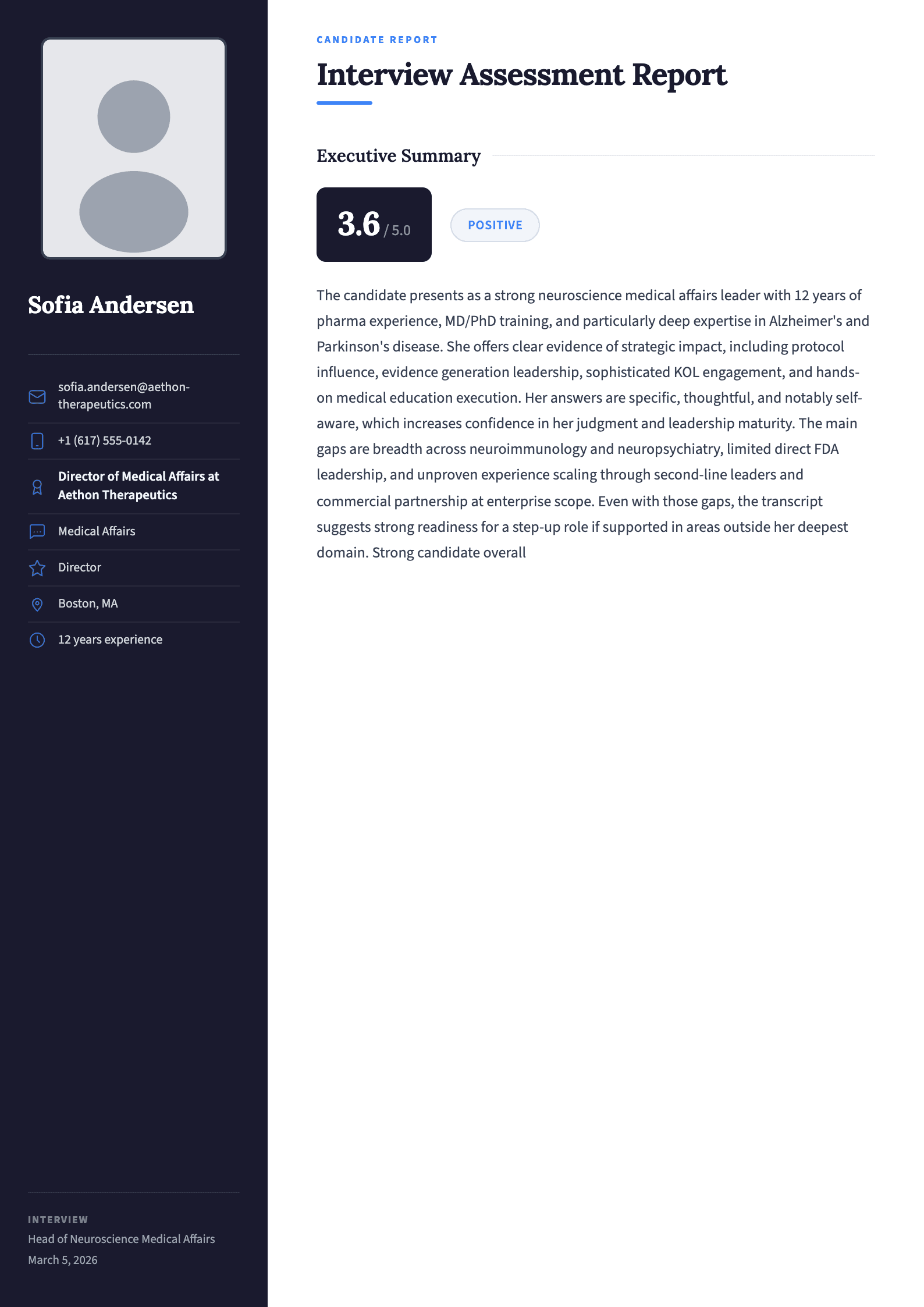
Classic Professional
Formal, structured layout with a bold header bar for a timeless look.
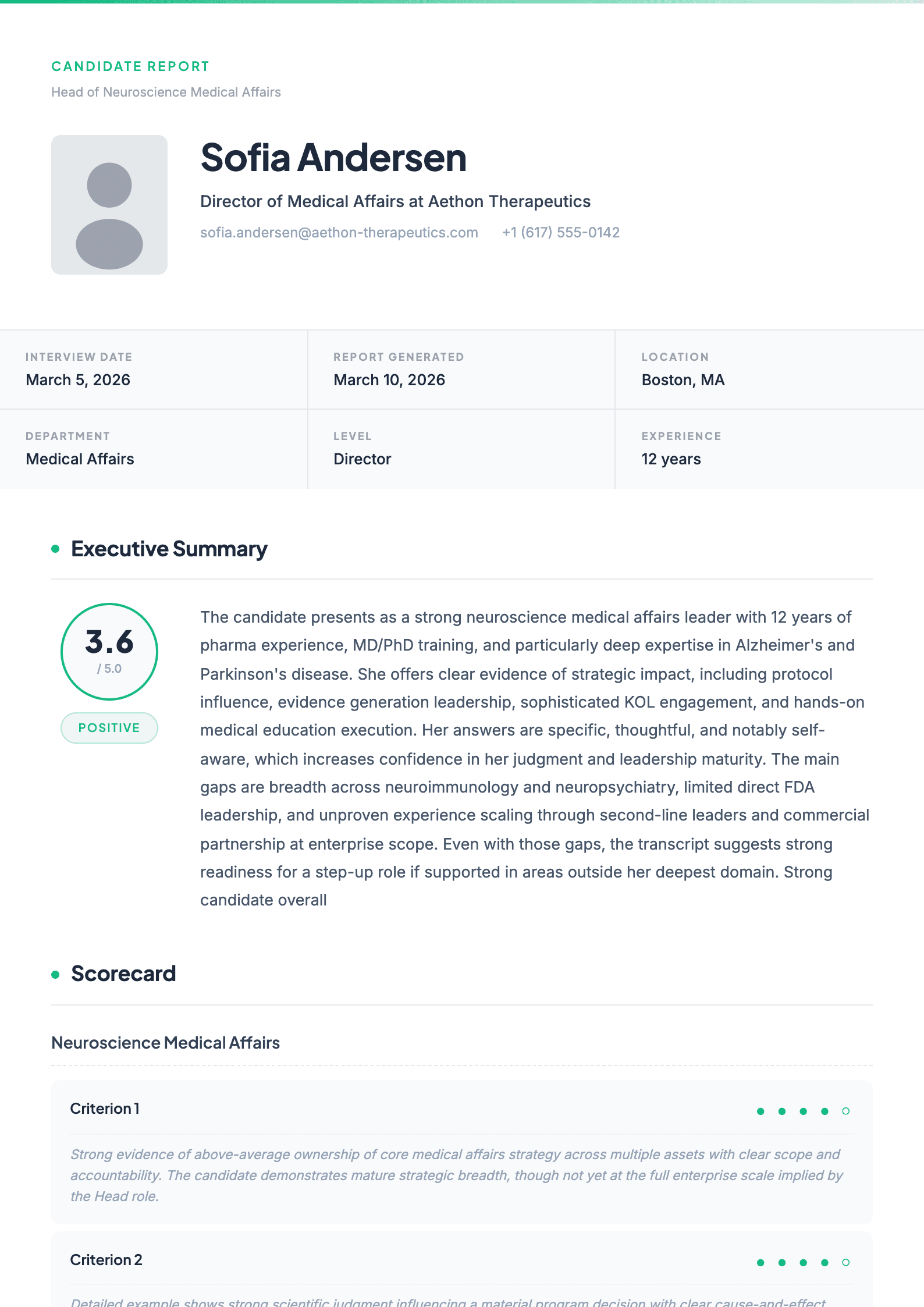
Modern Minimal
Clean, airy design with generous whitespace and subtle typography.
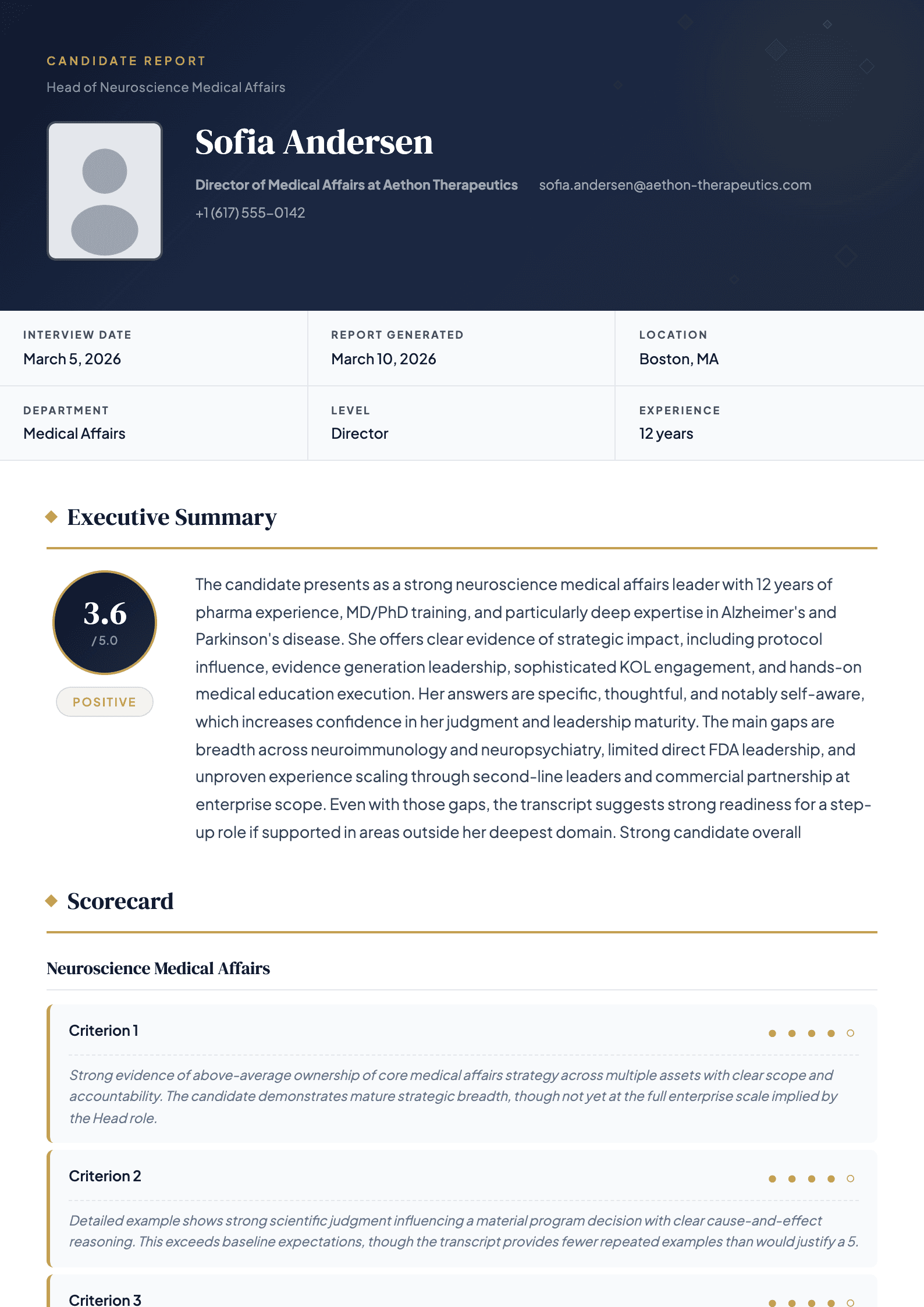
Executive Summary
Premium dark header with gold accents — built for senior-level assessments.
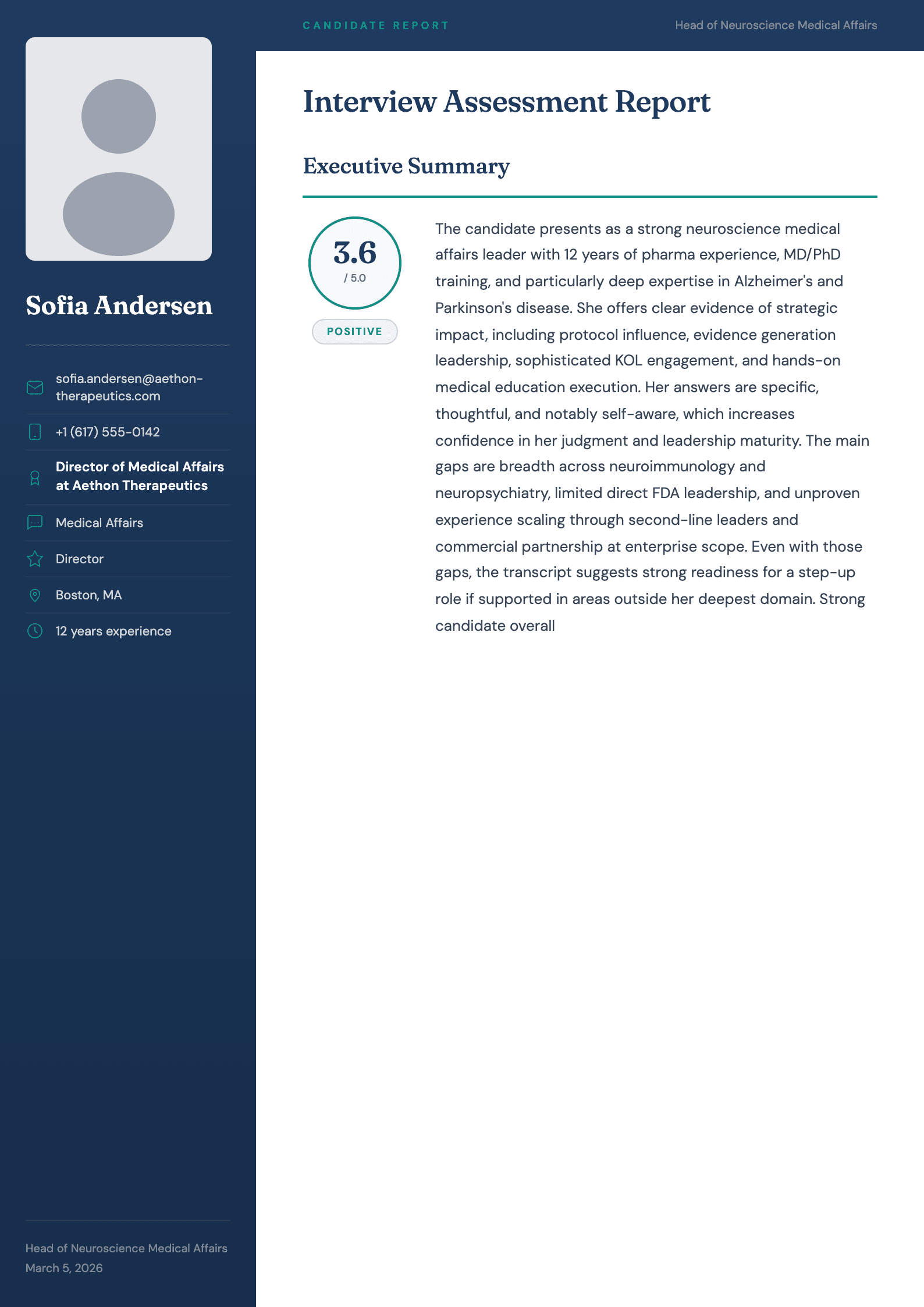
Navy & Teal Sidebar
Distinctive two-column layout with a navy sidebar and teal highlights.
Custom designs included with Starter and Pro plans.
Built for Your Workflow
Ready to use in minutes with pre-built defaults — customize everything to match your exact hiring process.
Everything you need, out of the box
Fields
Templates
Scorecards
PDF Designs
Tailor every detail to your process
Simple, Transparent Pricing
Start free, upgrade as your team grows. No hidden fees, no surprises.
Frequently Asked
Questions
Everything you need to know about TalentBrief before you sign up.
What's on the Roadmap
We're building fast. Here's what's coming next.
Sign up now and lock in 20% off forever.
LinkedIn Integration
Next upImport candidate profiles and sync hiring decisions directly from LinkedIn.
Interview Recorder Extension
Browser extension to record audio interviews directly — no separate recorder needed.
Candidate Sourcing
Pull candidate context from external links, websites, and profiles automatically.
Export Variety
Export candidate reports as Docx, CSV, and more formats for your existing HR workflows.
Have Questions?
Let's Talk
Whether you're interested in a demo, need enterprise pricing, or have general questions — we'd love to hear from you.
Or email us directly at support@talentbrief.io